In this article
Most small skincare brands don't struggle with ideas. They struggle with deciding, every single morning, what to post today. That's how a feed ends up with three product shots in a row, then nothing for ten days, then a rushed sale post.
The fix is a plan you make once a month. It takes about two hours, and after that, posting is just following the list. Here's the exact process, plus a 4-week plan you can copy.
Step 1: Pick a pace you can keep
Posting every day for two weeks and then disappearing does more damage than posting three times a week, every week. Choose the number you can hold on your busiest month, not your best one.
For a small brand, a good starting point is:
- 4 feed posts a week, for example Monday, Wednesday, Friday and Sunday. That's 16 posts a month.
- Stories on most days. They don't need to be designed. A poll, a question box or a quick photo of your day is enough.
The rest of this guide uses 16 feed posts a month. If you post less, keep the same balance and scale it down.
Step 2: Split your posts into 6 types
If every post is a product shot, people stop seeing them. If every post is a tip, people forget you sell anything. A mix fixes both. Here's how 16 posts break down:
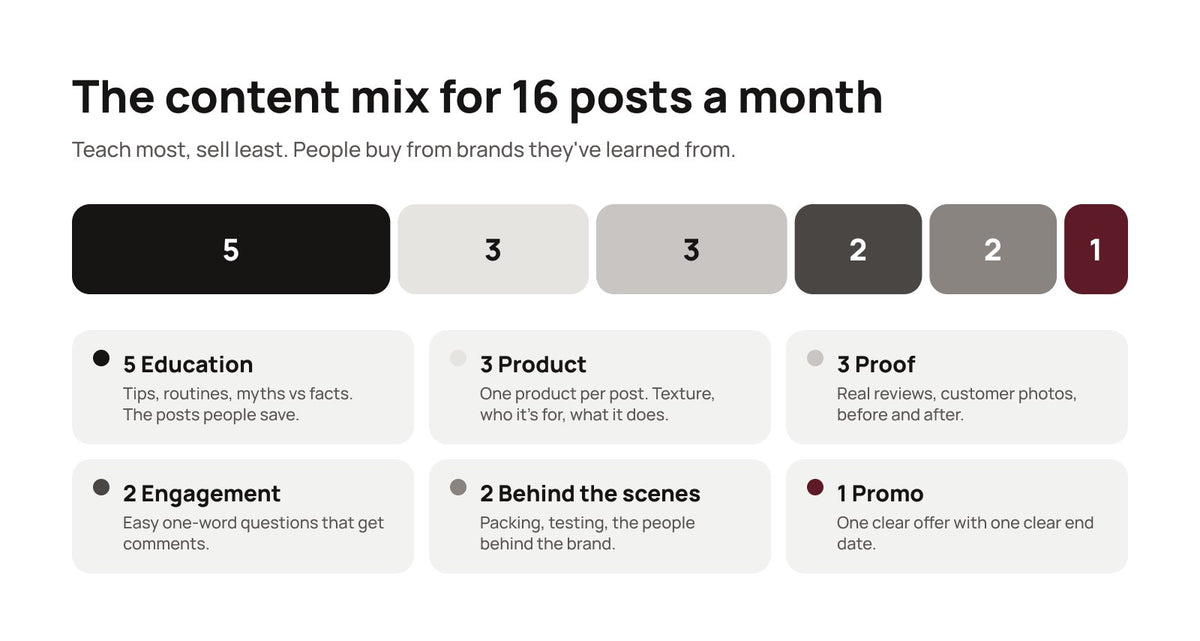
- Education (5 posts). The biggest share, because it's what people save and share. How to layer serums, how to patch test, myths vs facts, what an ingredient actually does.
- Product (3 posts). One product per post. Show the texture, say who it's for and what it does in one sentence.
- Proof (3 posts). Reviews, customer photos, before and after. Only use real results, and ask for permission before you repost anyone.
- Engagement (2 posts). Questions that are easy to answer in one word: "Gel or cream?", "Morning or night routine?". Comments tell Instagram your post is worth showing.
- Behind the scenes (2 posts). Packing orders, testing a new formula, the person behind the brand. This is what makes people trust a small brand over a big one.
- Promo (1 post). One clear offer with one clear end date. If you sell in every post, nobody notices when you actually have a sale.
Step 3: Map the month in 4 weeks
Before you fill anything in, mark the dates that matter: a launch, a holiday, payday, a restock. Put your promo post a few days before the biggest one. Then give each week a simple theme so the posts feel connected instead of random.
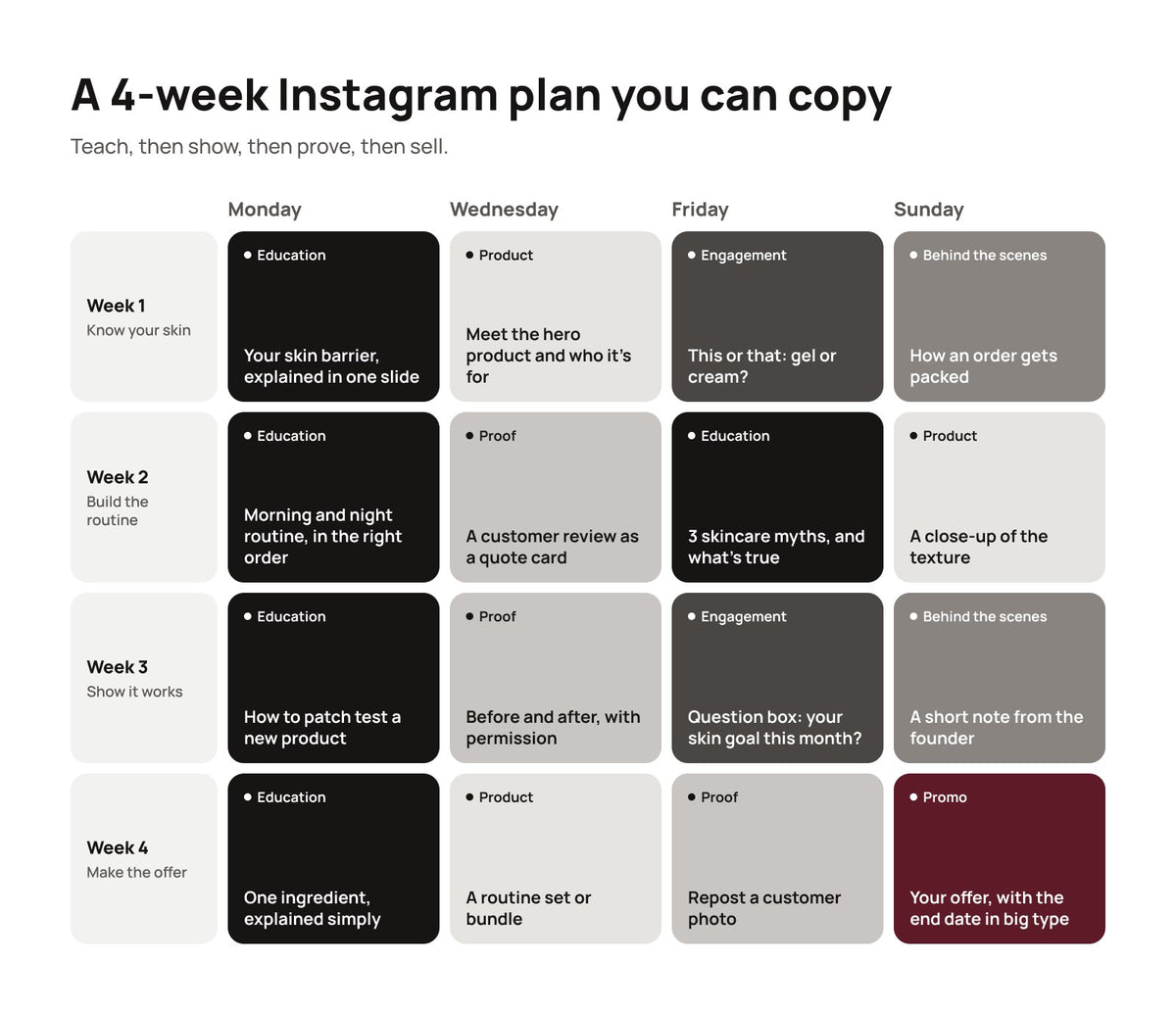
Here's the same plan as a list you can copy:
Week 1: Know your skin
- Mon, education: "Your skin barrier, explained in one slide"
- Wed, product: introduce your hero product and who it's for
- Fri, engagement: "This or that: gel or cream?"
- Sun, behind the scenes: how an order gets packed
Week 2: Build the routine
- Mon, education: the right order for a morning and night routine
- Wed, proof: a customer review, designed as a quote card
- Fri, education: 3 skincare myths, and what's actually true
- Sun, product: a close-up of the texture
Week 3: Show it works
- Mon, education: how to patch test a new product
- Wed, proof: a before and after, with the customer's permission
- Fri, engagement: a question box, "What's your skin goal this month?"
- Sun, behind the scenes: a short note from the founder
Week 4: Make the offer
- Mon, education: one ingredient, explained simply
- Wed, product: a routine set or bundle
- Fri, proof: repost a customer photo
- Sun, promo: your offer, with the end date in big type
Notice the order: the month teaches, then shows, then proves, then sells. By the time the offer arrives, people already understand the product and have seen it work.
Step 4: Write captions with one simple formula
Captions slow most people down more than design does. Use the same three parts every time:
- Hook. The first line has to stop the scroll, because it's all people see before "more".
- One useful point. Not five. One thing they can remember or try tonight.
- One action. Save this, comment, tap the link in bio. Pick one, not all three.
Example for an education post:
Your serum isn't working? It might be the order.
Apply skincare from thinnest to thickest: toner, serum, moisturizer, then SPF in the morning. Thick creams first block what comes after.
Save this for your next routine.
Write all 16 captions in one sitting. It's much faster than writing one every day, because you stay in the same headspace.
Step 5: Make the feed look like one brand
A consistent feed looks like a real business at a glance, and that matters for a small brand people haven't heard of. You don't need a designer for this, just a few rules:
- 2 to 3 colors and stick to them in every post.
- 1 or 2 fonts. One for headlines, one for small text.
- A few repeatable layouts: one for tips, one for reviews, one for products, one for offers. People learn to recognize them.
- One photo style. Same light, same kind of background.
This is where templates save the most time. You set your colors, fonts and logo once, and every post after that starts 80% done.
Step 6: Batch it in two sessions
Don't design on the day you post. Split the work into two blocks at the start of the month:
- Session 1, about an hour: fill in the 4-week plan and write all the captions.
- Session 2, about an hour: make the 16 posts, then schedule them with Meta Business Suite, which is free.
After that, your daily job is replying to comments and posting a story. That's it.
Step 7: Check what worked after 4 weeks
Likes are the least useful number. At the end of the month, open your Instagram insights and look at these instead:
- Saves: the posts people want to come back to. Usually education.
- Shares: the posts people send to a friend. These bring new followers.
- Comments: which questions got people talking.
- Link clicks and profile visits: which posts actually led to your shop.
Keep the post types that did well next month, and swap out the ones that didn't. After two or three months you'll know exactly what your audience wants.
One thing to watch: skincare claims
Words like "cures", "treats" or "heals" can turn a cosmetic into a drug claim in the eyes of regulators, and they're also the fastest way to lose trust. Describe what people can see and feel, such as "skin feels softer" or "less tight after cleansing", and only share numbers you can back up.
Keep reading
Want to go deeper on each step? Read how to write skincare captions that sell, how to make product photos look consistent and 7 Instagram story formats that get replies. Planning a launch inside the month? Use these 10 launch post ideas.
Want the month already done?
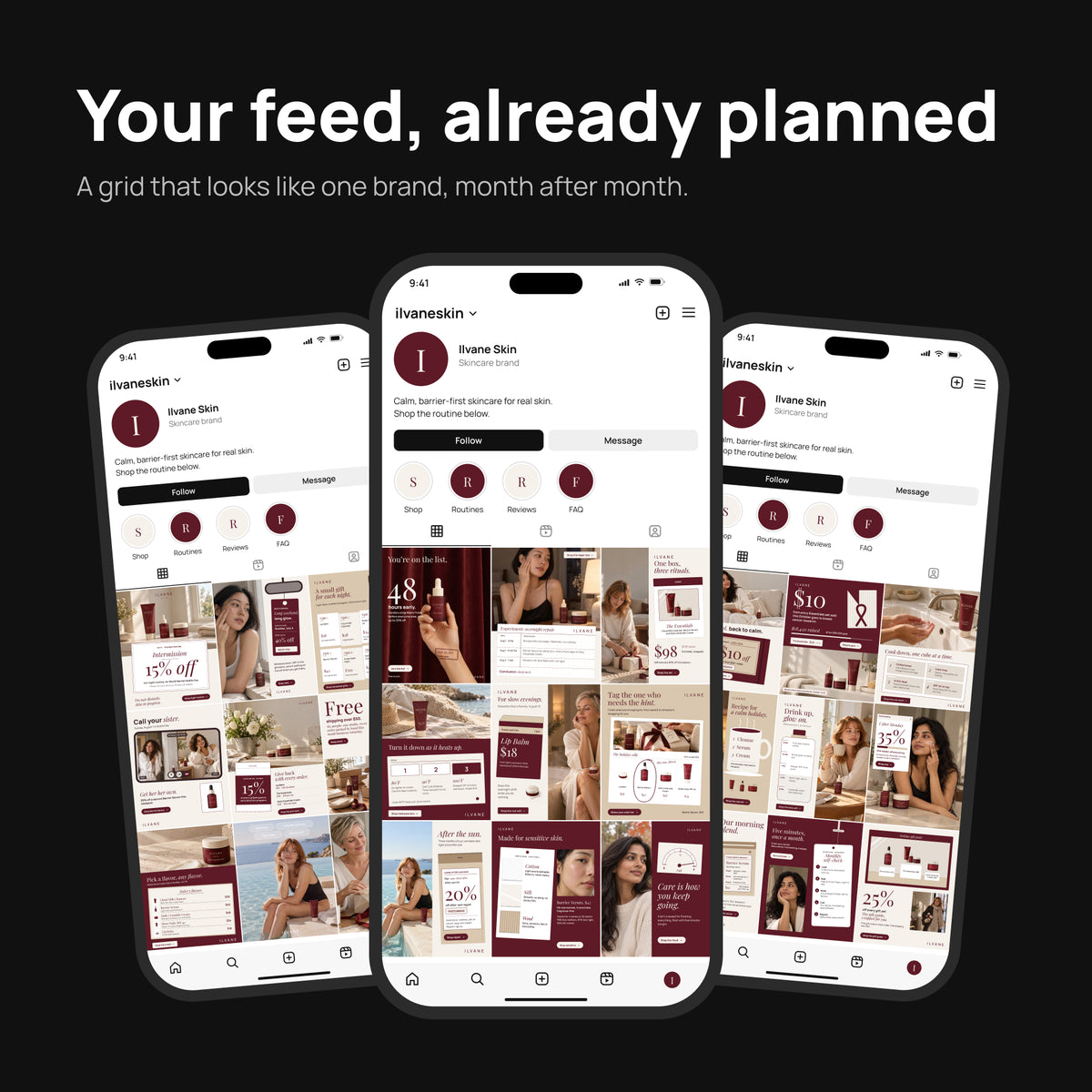
If you'd rather skip the blank page, we made the Ilvane Skin social kit for exactly this. It's a full year of Instagram content for a skincare brand: 697 feed templates covering January to December, each with a caption already written, plus 124 story templates and 124 ad banners.
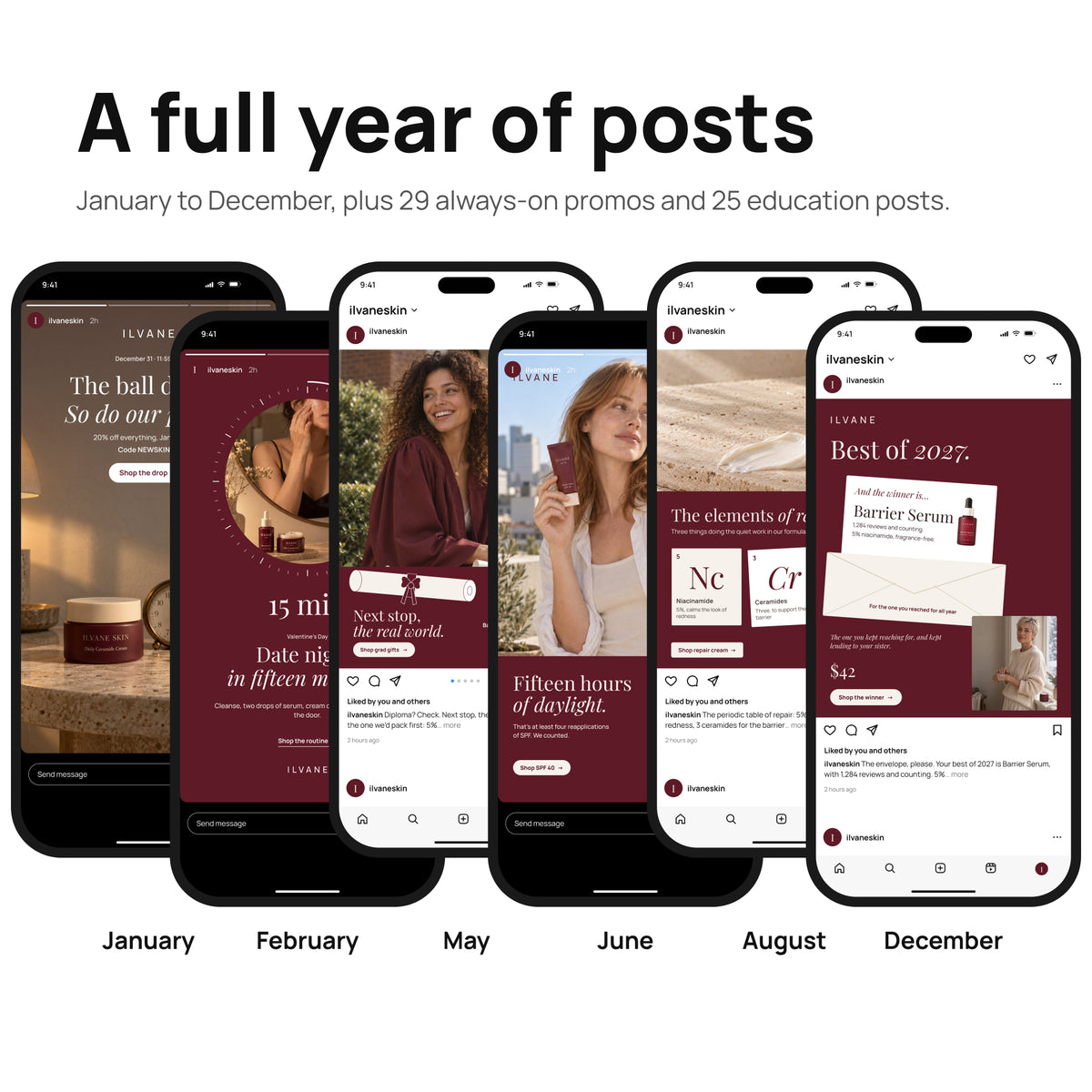
Every post type in this guide is already in there: education, product, proof, engagement, behind the scenes and promos, with every major holiday planned. You swap in your own logo, colors, photos and words, in Figma or Canva.